Outdoors & Coast
Wooltack Point Coastwatch: Volunteers Keeping Pembrokeshire Waters Safe
Coastwatch volunteers monitor shipping and pleasure craft to keep waters safe.
As the ‘eyes and ears’ on the coast, the Wooltack Point lookout post plays a vital role in keeping our waters safe When we think of safety at sea, our minds – understandably – tend to jump straight to HM Coastguard and the heroic volunteer lifeboat crews of the RNLI, but – unbeknown to most of us – there is a third emergency service saving lives on land and sea. Known as the ‘eyes and ears around the coast’, Coastwatch volunteers monitor vessels – from oil tankers to pleasure craft – in our waters and liaise with their more famous colleagues whenever danger strikes. The charity – which is designated a HM Coastguard Search and Rescue asset element – was founded a little over 30 years ago following the death of two young fishermen near a former Coastguard lookout station in Cornwall. In the wake of the tragedy, a group of mariners set about re-opening closed lookouts all along the British coast.
To date, 61 stations have been re-opened, each run completely independently, with local volunteers taking responsibility for the management of their own lookout. Today, the charity boasts just over 2,800 volunteers. In West Wales, Coastwatch is based at Wooltack Point, near Marloes in Pembrokeshire, where teams monitor the treacherous Jack Sound and the nearby waters and coastline. The station was originally constructed in 1935 and has played several significant roles throughout its history. During the Second World War and the Cold War, it served in various military capacities. Later, it was utilised as a Coastguard lookout post until its closure in 1994. The station was in dire need of repair when it came into the Coastwatch fold, and a fundraising campaign was required to restore it to full working order. The work was completed in 2010. The lookout, which costs around £6,000 per year to maintain, is run entirely on public donations and local fundraising, receiving no support from local councils or the government.
Inside the Wooltack Point lookout
“Our vision is to open more often, ideally seven days a week,”
Currently, the station is limited to operating five days a week between 10am and 4pm in winter and High technology and sophisticated systems such as radar have vastly improved safety at sea, but there is no substitute for a watchful pair of eyes.
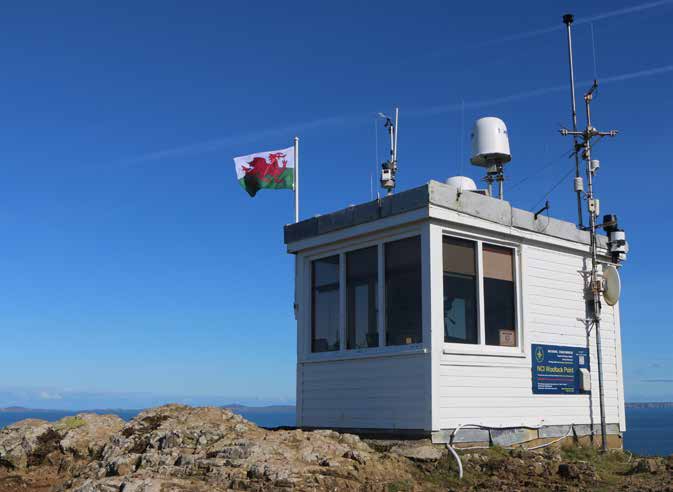
The Coastwatch lookout station at Wooltack Point, Pembrokeshire, today, and (below) how it was back in 2009.
Volunteers watching the coast
10am to 6pm in summer but the team hopes to recruit further volunteers to expand operations to full seven-days-a-week cover in future. At present, the Wooltack Point team consists of 12 qualified watchkeepers and three trainees. “Our vision is to open more often, ideally seven days a week,” said station manager Haydn Evans. “To achieve this, we would need upwards of 38 Watchkeepers available to be able to cover opening hours from 10am to 6pm daily, seven days a week.” Volunteers, who all undergo training to the high standards demanded by HM Coastguard, are expected to be available for just 12 hours per month minimum. The current team is made up of individuals from all walks of life and all ages. The station is fully equipped with advanced technology such as Marine VHF radios, an Automatic Identification System for identifying shipping and other craft, up to the minute weather monitoring systems and very high-powered scopes and binoculars.
However, the cutting-edge equipment is useless without trained operators. “High technology and sophisticated systems such as radar and telecommunications have vastly improved safety at sea, but there is no substitute for a watchful pair of eyes,” said Haydn. “Accidents do happen, and a computer or technology cannot spot a distress flare, an overturned boat, a yacht with problems, a water sports enthusiast in difficulty, children or adults in trouble, or possible pollution incidents. “That is why our station and watchkeepers are so important to all those who use our coastal waters, footpaths and coastline. Our watchkeepers provide a vital link with all the emergency services and can provide an emergency contact point on land for both sea and shore users. “As the ‘Eyes and Ears’ around the coast, our role can be summarised as to Spot, Plot, Report, Respond.” Not only do Coastwatch volunteers monitor the water traffic around the station, they also watch out for walkers, climbers, horse riders – anyone using the land and sea around Wooltack Point. “Last year alone, we logged more than 7,000 vessels and were involved with nine incidents, all of which could have ended very differently had Coastwatch not been there,” said Haydn. If you would be interested in finding out more about volunteering – or to make a donation, contact Haydn on 07927 321164 or visit nci.org.uk/stations/wooltack-point