Culture & Heritage
Dylan Thomas and the Artists Inspired by West Wales
West Wales as an inspiration to generations of creative people.
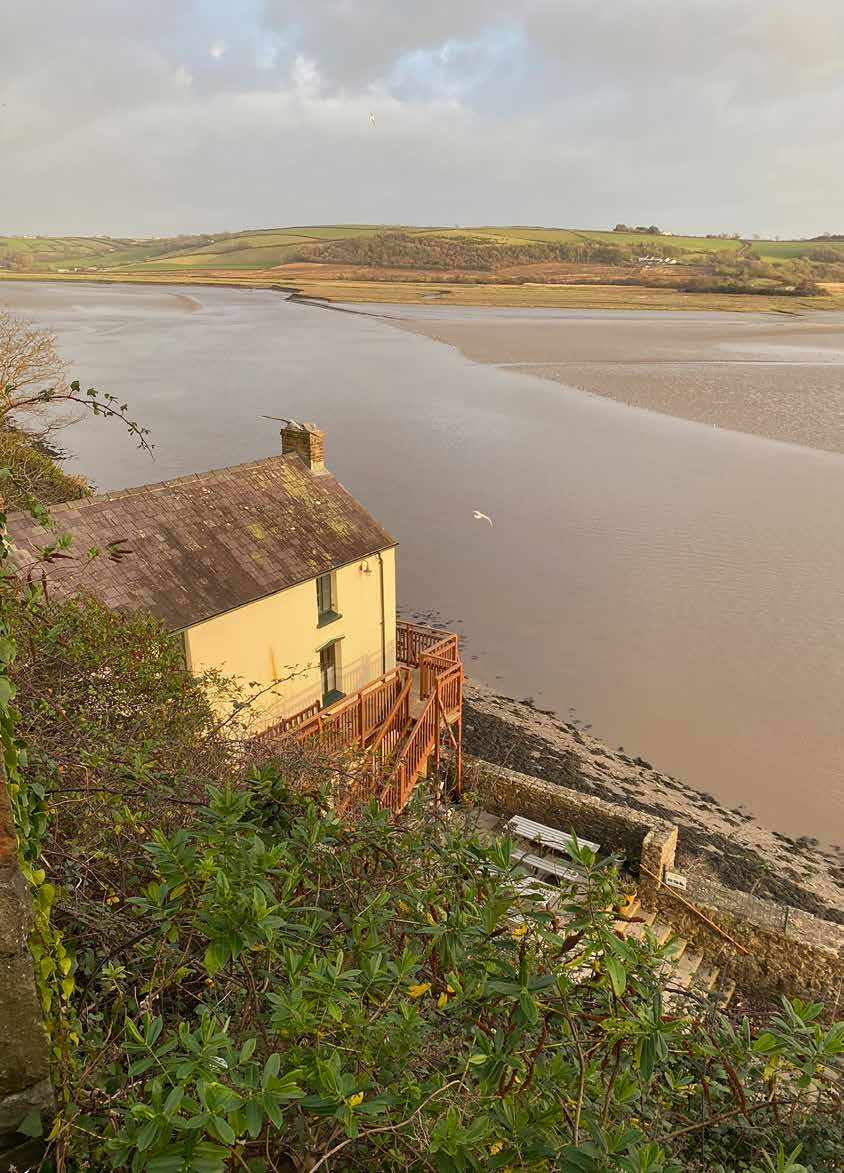
On a wooded walkway overlooking tidal mudflats of the Taf estuary and the wider horizons of Carmarthen Bay, stands a simple shed. Within, a bookcase, a basket of logs for the nearby wood stove and a simple desk, on which sheets of paper devoted to jottings and wordplay are scattered. A few pictures are pinned to the wall, but the sea-facing window provides its occupant with a constant view of the masterpiece of land, sea and sky. This is the Laugharne writing shed of Dylan Thomas: poet, actor, reporter, wit, lecturer – famed for his ‘play for voices’, Under Milk Wood; for his ‘sacred drinking myth’ - although he was often seen just nursing a half-pint, and was reportedly aghast when someone produced a bottle of whisky in an office, and mourned for his death at the age of 39 in a New York hospital. Thomas’s roots were in nearby Swansea, his father – a teacher – reputed to be one of the finest Shakespearean readers and scholars of his generation, no doubt nurtured in young Dylan a love of words, and the sound of words. Dylan’s creative heyday spanned the 1930s and 40s, but despite his growing literary reputation, money was a constant source of anxiety; a pressure, in part, relieved by the help of wealthier friends and patrons, such as the wife of historian, AJP Taylor. In Thomas, Margaret Taylor probably saw the opposite of the donnish world inhabited by her academic husband. She took the extraordinary step of purchasing the Boathouse for the poet and his family – a moment of huge relief for the struggling writer. “You have given me a life,” he wrote to Margaret. “And now I am going to live it.” Yet despite the achievement of permanence – the perfection of poems inspired by Carmarthenshire’s Fernhill farm, Sir John’s Hill (at the edge of Laugharne) and “the heron-priested shore” before Dylan’s very window, he seemed to be on a trajectory to disaster.
His biographer, Paul Ferris, records these end-years which led to coma and death in 1953, in chapters entitled, ‘Running Faster’ and ‘The Knot’ – words and situations which, somehow, do not fit at all with the image we have of a man at one with Nature; able to describe a typical Carmarthenshire springtime, as if it were “one of the first springs that the world had ever experienced.” Yet Thomas was not the only Welsh poet of his time and place. Born in Glamorganshire in 1906, Vernon Watkins – a great friend of Dylan’s (despite Thomas failing to appear as best man at his wedding) – achieved fame for poems such as The Collier, which tells the story of a young boy who attended the county school, carving his name into his desk - “Di, for dynamite” - and fished for trout in the stream, yet was destined to die in an accident in a coal mine. The pickaxes of the rescue party could not break through in time, so when brought to the surface, the sunlight of the day shone only on the collier’s lifeless body. The poem is as much about the life of Wales in an era that has gone, as it is specifically about the collier of the title, so much so that Dylan himself recorded Watkins’ work for a poetry-anthology broadcast. But Vernon was also a troubled man, suffering bouts of mental instability. Despite carefree days when he and Dylan had pondered their old age as distinguished gentlemen, as “men of letters”, the reality turned out to be somewhat different. At one grave moment of crisis, Vernon – believing that angels would be there to hold him up – threw himself off the side of a building. The heavenly host must surely have intervened, as he survived to tell the tale. During the war years, Vernon served in the RAF – his brain being put to very good use in the Intelligence and code-breaking services.
Dylan Thomas and the Laugharne landscape
Deeply affected by his friend’s untimely demise in America, Vernon lived on in relative obscurity in the Gower – no doubt dreaming of old Swansea days – in the quiet, dull routines of a conventional working life spent in one of our well-known banks. His last work Fidelities was published in 1968, a year after his death. As the life of Vernon Watkins drew to its close, another Welsh creative – this time, a composer – was in the full flush of endeavour and composition. William Mathias was born in Whitland, Carmarthenshire, in 1934. During the 1960s, three concerto pieces – two for piano, and one, a Concerto for Orchestra – had attracted the attention of the musical world. A symphony was also written in that decade – an abstract work, with no programme, or story, or even overt links to folklore and landscape. And yet in his writing and orchestration, Mathias seems to be a sort of musical incarnation of a Dylan Thomas poem: a strange sense of a coastal view, looking perhaps toward a prehistoric earthwork, or a ruin in the landscape from a people who lived, time out of mind. Mathias was greatly interested in “the matter of Britain” – the inheritance of myth and legend; the sound of water over stones, of a veil of rainfall leaving a glistening shield of reflected light on craggy outcrops where hermits pondered eternity. His symphonies explore this subliminal terrain: his shorter, Celtic Dances – written in 1972 – offer a more boldly-defined Cymric spirit in music, but still an uncanny experience, that makes the listener feel as though the composer is leading you to unconjectured, mythical realms.
identity is present in the works of Pembroke-born, Daniel Jones (1912- 1993) – a friend of both Dylan and Vernon, and part of their bohemian Swansea ‘gang’ that flourished before the war. However, Daniel often spoke of himself as a composer who just happened to have been born in Wales, rather than a “Welsh composer”. Nevertheless, his many works – a cycle of string quartets, recorded on CD some years ago to critical acclaim by the Chandos label, have an inescapable atmosphere which seems to belong, alone, to the land west of the Severn bridges. It could be a case of the listener projecting his or her feelings onto the music, but however you might feel when playing the recording, there is no doubting the intricacy, beauty and universal appeal of these finely sculpted works.
A wider West Wales creative tradition
informal, approachable man – none of the tortured genius, shunning the world. I know that to be true, as many years ago, at the 1982 Proms season, I attended a concert given by the then BBC Welsh Symphony Orchestra – now, the BBC’s National Orchestra of Wales. Daniel Jones’s work, A Dance Fantasy was performed in the concert, and at the end, by the artists’ entrance at the Royal Albert Hall, I spotted the composer. Approaching this unassuming figure – informally dressed and minding his own business – I asked if he might sign my programme, which he cheerfully did in a neat hand. Uttering a garbled sentence or two about how much I had enjoyed the piece, and how I had heard his music once on the radio, I thanked him, nodded and went on my way – my one contact with someone who knew the legend that was Dylan Thomas. The views of the South and West Wales coast and countryside have – for generation - shaped its writers and composers, and indeed all who live here, or have come to live here.
It is a remarkable 20th-century history of achievement, of a rebirth in cultural identity, that generates a warm glow of recognition. The words and music of Wales.