
Culture & Heritage
Edmund Tudor in West Wales: The Father of King Henry VII
The West Wales story of Edmund Tudor, the man who made a king.
Adding a fireplace brings a great deal of value and personality to almost any home, add a fireplace to you home and increase its value by 12%. A fireplace creates a centrepiece for a room. It becomes a gathering place and focal point in any home.
Nothing makes a house into a home more than the sounds and smells of a crackling wood fire on a cold winter night. The flicker of the flames adds an aura of romance to any room.
est Wales might not seem like the obvious place to find a Tudor prince but in the mid-fifteenth century, it was the centre of operations for Edmund Tudor, Earl of Richmond. Today he is best remembered for being the husband of Margaret Beaufort and father to the future king Henry VII. Edmund famously died whilst his teenage wife was pregnant, but prior to his premature demise in Carmarthen on November 1, 1456, he led a life of military service to the English crown and had been responsible for dealing with troublesome Welsh landowners. Gruffydd ap Nicholas, like many others, had taken advantage of the weak English crown and its divided leadership, and had decided to exploit the situation in Carmarthenshire by raiding, seizing castles and disobeying royal orders.
Things came to a head when he seized the lordship of Carmarthen and was being hailed widely as the town’s ‘eagle,’ a Welsh saviour. Something had to be done – Gruffydd could not be allowed The tomb of Edmund Tudor, 1st Earl of Richmond and father of Henry VII, in St David’s Cathedral.
to challenge English control, and Edmund Tudor was the obvious choice for the job of reining him in. Edmund was born around 1430 at Much Hadham Palace in Hertfordshire, about as far away from southwest Wales as you could get during the medieval period, but he was the son of the dowager queen Katherine of Valois and Owen Tudor, a man of impeccable Welsh ancestry. Edmund was also half-brother to Henry VI. He also had a younger brother, Jasper. By 1454 Edmund was in his mid-twenties and ready to prove himself to the king. Richard, Duke of York, was acting Regent at the time, during one of the king’s many illnesses, and he sent Edmund west hoping that his emissary’s Welsh ancestry, coupled with the fact that Edmund shared some distant familial relationship with Gruffydd ap Nicolas, would make him a palatable choice as the King’s representative in West Wales. Edmund and his new young wife – he had married the 12-year-old heiress Margaret Beaufort earlier in the year - headed for Wales, reaching Lamphey Palace near Pembroke in November 1455 and establishing his headquarters.
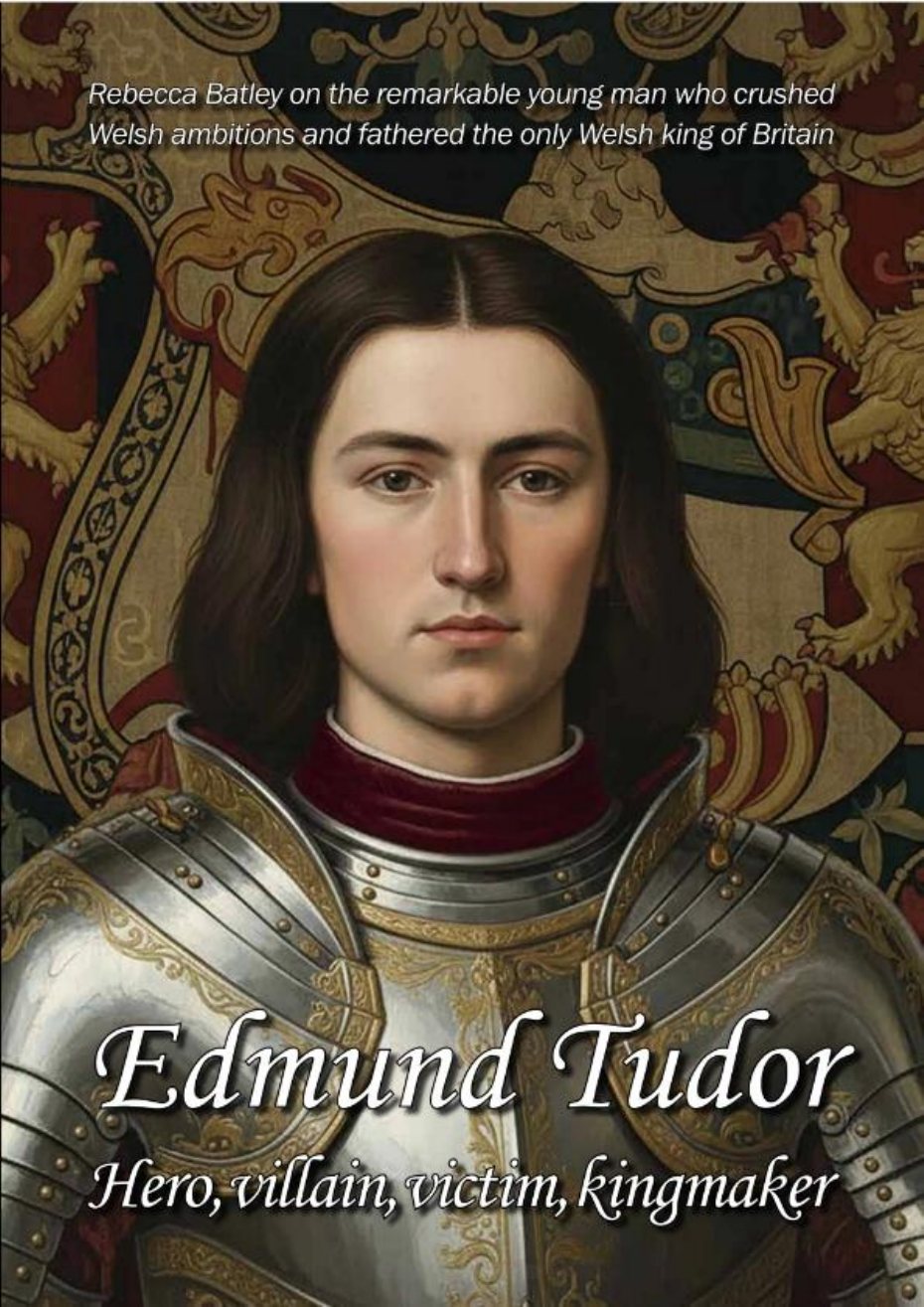
By the end of the year, Margaret was pregnant, despite her youth, and Edmund began to face his difficult task. Over the previous two years Gruffydd ap Nicolas had taken The funeral brass of Edmund Tudor atop his tomb in St David’s Cathedral. The image on page 45 was generated by AI using this brass as its model.
Edmund Tudor’s West Wales campaign
In 1538, Edmund Tudor’s tomb was moved to stand before the high altar in St David’s cathedral.
possession of the castles in Aberystwyth, Carmarthen, Kidwelly and Carreg Cennen, near Llandeilo. Edmund was charged with taking them back.
He quickly entered into a ‘war’ with Gruffydd and – thanks to a combination of military acumen, good supplies and the ever-shifting network of local alliances – proved remarkably successful in systematically dislodging him from each castle. By all accounts he managed the situation well, courting local support and achieving great success. By June, he had retaken Aberystwyth and his campaign quickly gained pace. The other castles soon fell. By August he had recaptured Carmarthen, after a just a few short bloody weeks. Following his glorious campaign, Edmund might reasonably have expected to be hailed as both a conqueror and the greatest Lord of southwest Wales, but back in London things had changed rapidly. The Duke of York had been ousted from power by the Lancastrian faction and Edmund Tudor, now with a powerbase of at least four castles in Wales, posed a huge threat to Richard’s own position. York wanted West Wales back, and very quickly Edmund found himself fighting his former allies as the Yorkist forces, led by Sir Walter Devereaux and Sir Walter Herbert of Raglan, headed west.
To make matters worse, York’s order reignited an age-old feud between the Tudor and Herbert dynasties in southwest Wales.
With the Yorkists closing in, Edmund Tudor made his stand in Carmarthen. Carmarthen had been home to a military stronghold since the Romans first built a fort there as the administrative centre of their They duly besieged the castle; no doubt violent skirmishes ensued over the next couple of months but by the end of autumn 1456 the Yorkists had taken the castle and captured the former hero. Here things become rather vague as the exact details of his treatment and imprisonment are not clear, but we do know that Edmund was held prisoner in Carmarthen. What is absolutely clear, however, is that by the November 1, 1456, Edmund Tudor was dead. The immediate reports to reach London claimed that he had died of the plague, he was after all half-brother to a king who held him in high affection, but quickly rumours began to circulate that he had met a far darker end. The Lancastrians soon sought revenge.
Death, dynasty and royal legacy
Both Herbert and Devereaux were quickly imprisoned for carrying out unlawful violence “against the King’s subjects.” The following year an enquiry, attended by Edmund’s brother Edmund might reasonably have expected to be hailed a conqueror and the greatest Lord of West Wales, but back in London things had changed rapidly. rapi allies, the Demetae tribe. Long after the Romans, the Normans had built a castle there in 1094. In 1405, Carmarthen was captured by Owain Glyndwr, who had also recognised the town’s strategic importance. Edmund, aged just 26, holed up in the castle to await his fate as Devereux and Herbert advanced on the town with around 2,000 men.
Jasper as well as Henry VI and his queen, was held into the events at Carmarthen. Unfortunately, the Lancastrians were in desperate need of allies and so Herbert was offered a pardon provided he fell in line behind the King. He accepted and the matter of Edmund’s untimely death was dropped. Edmund’s body was taken into the custody of the Greyfriars of Carmarthen. He was buried in the quire of the monastic church. At the time of his death, Edmund’s Edmund – with his 12-year-old wife, Margaret Beaufort – set up headquarters at Lamphey Palace near Pembroke in November 1455. teenage widow was heavily pregnant. She Though Edmund was dead before When the Greyfriars monastery gave birth to his son and heir on he was even born, Henry did not was dissolved in 1538 by order of January 28, 1457, at Pembroke forget his father, nor his connections his grandson, Henry VIII, Edmund castle, under the protection of to West Wales.
The following year an enquiry, attended by Edmund’s brother Jasper as well as Henry VI and his queen, was held into the events at Carmarthen. Unfortunately, the Lancastrians were in desperate need of allies and so Herbert was offered a pardon provided he fell in line behind the King. He accepted and the matter of Edmund’s untimely death was dropped. Edmund’s body was taken into the custody of the Greyfriars of Carmarthen. He was buried in the quire of the monastic church.
At the time of his death, Edmund’s teenage widow was heavily pregnant. She gave birth to his son and heir on January 28, 1457, at Pembroke Castle, under the protection of Jasper Tudor. The child would in time become King Henry VII, founder of the Tudor dynasty.
Though Edmund was dead before he was even born, Henry did not forget his father, nor his connections to West Wales. He would land at Milford Haven on his way to a date with destiny at Bosworth Field and, when king, he commissioned a new tomb for his father. When the Greyfriars monastery was dissolved in 1538 by order of his grandson Henry VIII, Edmund Tudor’s tomb was moved to stand before the high altar in St David’s Cathedral, where today it is visited by hundreds of pilgrims and history enthusiasts every year.