Travel & Places
Exploring the Gwili Valley Railway and Industrial Heritage
The Gwili Valley in Carmarthenshire follows the River Gwili north from Carmarthen, through wooded countryside shaped by railway and industrial history.
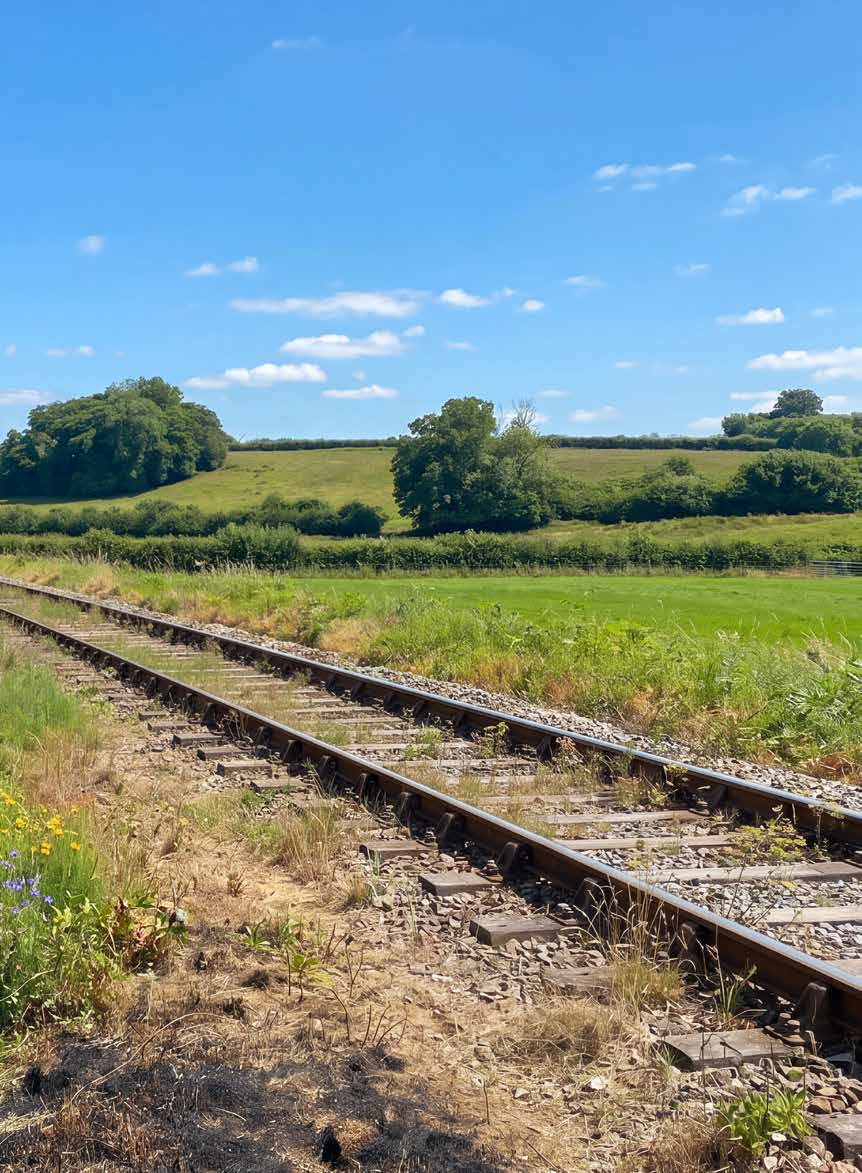
The Gwili Valley lies north of Carmarthen, following the River Gwili through wooded countryside towards Cynwyl Elfed and beyond. Its best-known visitor attraction is the Gwili Valley Railway at Bronwydd, where part of the former Carmarthen to Aberystwyth line survives as a heritage railway.
Summer is the season when the visitors begin to flock to West Wales – and Pembrokeshire, it has to be said, is undoubtedly the most popular of the three counties for caravanners, trekkers, walkers and those hoping to find a long sandy beach, with the chance to swim on a warm day, or surf a breaker from the swell of the wider Atlantic. Yet for those hoping to avoid the throng another kind of experience can be discovered, much further inland and shaded from the sun in the less-traversed countryside of northerly Carmarthenshire; a densely wooded, Tolkien-reminiscent landscape of thickly-oak-wooded gorges, through which flows a wild spate river about which very few - even here in Wales - seem to know. Millions of years old is this valley and stream threading mysteriously along the maps of the county; its name deriving from old Welsh words meaning wild and flux – Gwyllt and Lli – or, in short, the Gwili; as fabled by poet, Dylan Thomas, in the moving soliloquy to Wales which he gave to his Under Milk Wood character, the Rev. Eli Jenkins. A gentle waterway in summer, A gentle waterway in summer attracting the angler and birdwatcher, but an Alpine-like torrent in winter.
making rocks glisten, and attracting the angler and birdwatcher, but an Alpine-like torrent in winter, almost fearsome in its flow, the river is quiet, semi-secret Cambria at its finest and most dramatic. The best way to approach the Gwili is from Carmarthen town, following the A484, a road which runs to the north-west of the county. And although your car will take you along the sometimes-breathtaking twists of the road, allowing you to take in the scenery which seems curiously like that of mountainous North Wales, the best way to appreciate the views are actually from the – raised - rear section of the wonderful 460-route bus service which runs, Monday to Fridays, every hour or so in the direction of Cardigan. It is from this vantage point that other features of the district are revealed: old mossy railway bridges, and a redundant overgrown trackbed – once the proud work of skilled engineers who built what must have been an elegant line alongside and above the Gwili’s quick-moving waters. The railway, though, has not entirely disappeared, and for those not expecting it, the sight of steam, semaphore signals, a working Great Western Railway signal box – half-hidden by the summer woodland canopy – can be a time-traveller’s surprise. First stop, then, is the old station at Bronwydd, which is also known as Bronwydd Arms after a long-gone watering hole in the valley, from which passenger branchline trains now clank along the preserved part of the track, run by the devotees and steam-lovers of today’s Gwili Valley Railway. Perfectly, authentically maintained, as if the 1930s or ‘40s had frozen, the platform and sidings take you back to a Wales in which farmers delivered their milk churns to the stationmaster; and passengers for Carmarthen or Newcastle Emlyn - the no-longer-there station terminus, some 15 or so miles on - boarded GWR or later, British Railways’ crimson-liveried coaches. Today, the railway also acts as a retirement home for many disparate locomotives and rolling stock: a surreal collection – like a home model railway – with 1960s’ railcars, which probably saw service on Northern and Pennine routes, shunted next to a vintage Royal Mail coach, and part of an Inter- City 125. At that moment, a saddle-or pannier-tank locomotive hauling a train packed with holidaying folk or rail enthusiasts passes by; the hardworking engines, once the mainstay of industrial yards, works and collieries, thankfully saved from the hammers and blow-torches of the Beeching years when steam was finally decommissioned. What is now the Gwili Valley Railway first came into being on the March 28, 1864 – a moment in D E S I G N E R FA B R I C S AT M A S S I V E LY REDUCED PRICES OPEN MON – FRI, 10AM – 4PM 1ST SATURDAY OF THE MONTH, 10AM – 2PM 1 S T S AT U R DAY E AC H M O N T H, 1 0 A M – 2 P M B R U N E L Q U AY, N E Y L A N D S A 7 3 1 P Y West Wales’s transport heritage, as described by rail historians, Stanley C. Jenkins and Chris Turner: “… the single line was again extended alongside the Afon Gwili to Conwil [now Cynwyl] to near Llanpumpsaint (Llanpumpsaint station, GWR), then climbing northwards along a tributary valley to cut through high ground by means of the 988-yard Pencader tunnel, descending thence into Pencader. The total distance was eight miles.” Yet by the 1960s, it seemed that Britain was turning away from its railways - or so officialdom claimed - and passenger services were duly withdrawn. The line, surprisingly, survived until the beginning of the 1970s, with the occasional goods train wending its way along increasingly weed-overgrown rails and sleepers, until even that dribble of commercial life came to an end.
How lucky we are that a fragment of a great railway lineage, founded in the 19th-century age of “railway mania” lives on at Bronwydd. At Danycoed, a lonely forest halt, is the sneaking, exciting sensation that the railway could re-seed itself back into the valleys. Time (and careful, determined fundraising) will tell… Part of an Inter-City 125 and a vintage Royal Mail coach (page 29) can be seen through the trees lingering on stretches of disused track along the Gwili line.
A journey through the Gwili Valley
a few miles from the main station and shunting yard, the train service must – for now – stop. But as you stand at that small station, looking out to the countryside beyond, there Darganfyddwch hanes y diwydiant gwlân yng Nghymru! Discover the history of the Woollen Industry in Wales!
Experience a delightful stay at Caban with stunning sea views, onsite restaurant, bar, right on the beach.
Get ready for a fantastic time at our 12-hole Crazy Golf Course! Exciting and family friendly We have lots going on at Caban this Spring & Summer. To be in the know, visit our website for event information.
• Crazy golf • Dry ski slope • Explore on cycle hire • Wales’ highest toboggan run • Adventure Playground • Walks & trails • Fully licenced restaurant 25th July - Family Fun Day 26th & 27th September - Steam Rally & Country Fayre 24th October - Spooky 5k Colour Run Adding a fireplace brings a great deal of value and personality to almost any home, add a fireplace to you home and increase its value by 12%. A fireplace creates a centrepiece for a room. It becomes a gathering place and focal point in any home.
Railway history and industrial heritage
Nothing makes a house into a home more than the sounds and smells of a crackling wood fire on a cold winter night. The flicker of the flames adds an aura of romance to any room.
The countryside of the Gwili, close to Cynwyl Elfed and Cwm Duad – a village with a preserved toll-keeper’s cottage – begins to climb, appreciably. This is the hilly district of the great watershed, opening out to fields and hill-farms, which separates, on one side, the River Teifi, and on the other, the tumbling stream that becomes the Gwili. The waters sometimes seem little more than a brook, but what we see around us is the work of titanic forces from the ancient, deep-past. The rocks, painstakingly recorded and admired by geologists of our lifetime, were deposited as mud and sand at the bottom of a deep, stagnant lake many hundreds of millions of years ago. It seems inconceivable, but at that time, what was to become Britain, was in fact squeezed and solidified rock located at the South Pole, pressed, crushed, pushed away slowly across the planet by the movement of giant continents.
And what was to become Wales began its long journey to the north – to where we sit geographically, today – as volcanoes crumpled and creased the Earth; as mile-thick ice, icecaps and meltwater incised deep channels into the dramatic V-shaped cascades and canyons that would in time become our Gwili Valley of today. Wonderful things to behold, wouldn’t you agree, from a West Wales bus or steam train service?