Travel & Places
Mwnt, Ceredigion: History, Geology and Coastal Landscape
The landscape, history and ancient church of Mwnt.
Just slightly to the north of Cardigan and Gwbert, a web of narrow country lanes thread through a bare farming landscape. Often set beneath the level of the surrounding fields, the lanes – medieval hollow-ways, originally – are steep-banked; their corners and unexpected bends in the road, often surmounted by a tree, hewn into a landward-facing supernatural shape by decades – centuries – of gusts from the sea. The farms themselves almost seem to have tucked their heads into their shoulders, to shield themselves from the wind. Years ago, the farmer would have had a bed for the night for the traveller, or welcome regular family visitors for their summer holiday, a wing of the farm or an outlying snug cottage or bungalow providing a holiday lodging for the anorak-or cagoule-wearing visitors of the 1970s.
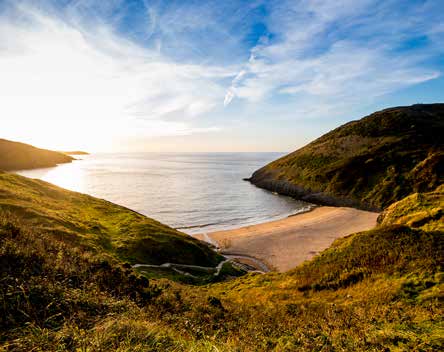
Today – in our age of online bookings and inspections by authorities, all demanding immaculate, box-ticked levels of amenities – the old-fashioned farm holiday seems to have faded… No matter. Just follow the lanes that are still there and the signpost marked simply, Mwnt (or Mount, as it appears on old Anglophone maps). Before you know it, a vista of sea, A soft, narcotic whispering of the waves from the bay deep below you lulls the senses: feel a tingle on the neck and in the heart.
cliffs and a miniature mountain hove into view: a moment of giddiness for those, like this author, who are disconcerted by a sense of sudden height and the large gaping bay which are suddenly upon you. Park your car, or bicycle, of if you have hiked, simply sit for a moment on one of Mwnt’s low stone walls and find your breath and bearings. A soft, narcotic whispering of the waves from the bay deep below you lulls the senses: feel a tingle on the neck and in the heart, as the wild cry of a herring gull, held in the breeze, reaches your ears; savour the sense of the wildness of the Celtic westerly coast of Britain. But you have no doubt come here, not just for the sea-fever, but because you have heard tell of a strange, lonely, ancient – even primitive – place of worship: Mwnt Church – the Church of the Holy Cross – Eglwys y Grog in Welsh. Yet when was Holy Cross built – this tiny, single chamber, a hermitage, almost, by the cliffs?
The ancient landscape of Mwnt
“Their subsequent defeat by the local Welsh inhabitants of the area was marked, at least in the 18th century when the events were recorded, by secular games played on the first Sunday in January, called, “Coch y Mwnt”
Shielded by ‘the mount’ from which the place takes its name – a physical feature as eye-catching and unusual as Silbury Hill in Wiltshire – the church is said to date from the 13th century: two hundred years after the Norman Conquest; the age of King John, Edward III, Edward I. However, at first sight, the onlooker might have a sense of the pre-Conquest world – the church, in its thick whitewashed stone, set into the turf like a prehistoric earthwork, suggesting the era of the very earliest Celtic saints who roamed this part of the land. Peaceful today in our eyes, one writer and historian has pointed to a more turbulent past, of warfare and invasion. Sarah Woodbury in her Journey to Medieval Wales recounts the following tale, of Flemish soldiers – eventually beaten in armed struggle by the Cymry – and brought to Wales by the Norman Conquerors, the same aristocratic and military class that had defeated the Anglo-Saxon English: “Their subsequent defeat by the local Welsh inhabitants of the area was marked, at least in the 18th century when the events were recorded, by secular games played on the first Sunday in January, called, “Coch y Mwnt”– the bloody Sunday of Mount.
Nearby is a farm with a well called Ffynnon Grog, the well of the cross, and Nant y Flymon, or the Fleming’s brook, where many human bones have been unearthed over the centuries.” It seems entirely probable that legends of the Flemings and the early guerilla warfare that broke them, captured the imagination of the countless pilgrims who visited Holy Cross on their way to pay homage or seek absolution at this lonely shrine of St David. Today, though, we tend to forget the presence of the Flemish in Wales, as we do the early Viking and Norse influence on the country; not to mention Scots and Hibernians in Arthurian times – the latter described by almost-forgotten antiquarians, such as author, W F Skene, who asks readers to picture these islands as places of warring dynastic civilisations on the Atlantic edge of Europe. A visit to Mwnt may inspire us all to seek out these memoirs and fragments of the past, as recorded by recondite researchers whose work now seems so vital to a true understanding of how we all came to be here. Yet other timelines and perspectives need to sink into our minds… such as the history of Mwnt’s cliffs. The rocks you see today were deposited between 440 and 450 million years ago, during the Ordovician geological period. At this time, the sandy beach of Mwnt Bay was – astonishingly – located in the Southern Hemisphere, when land was unvegetated and exposed rocks brought large quantities of mud and sand onto a narrow shelf.
History written into the coast
Because the sediment was deposited at the active edges of adjacent tectonic plates, earthquakes and tidal waves would have been common, causing different textures to have been formed in the mud-stone. Hundreds of millions of years later, the Welsh and Irish ice-sheets came together to join the island of Mwnt to the mainland with a layer of glacial deposits, many hundreds of feet thick.
Such are the layers of Welsh history – and before our swords, symbols and crosses came to mark the landscape, the powerful Earth-forces which shaped this quiet, special place on the picturesque Cardiganshire coast.