Travel & Places
Llangrannog, Ceredigion: History, Legends and Coastal Life
The saints, giants and stories behind Llangrannog.
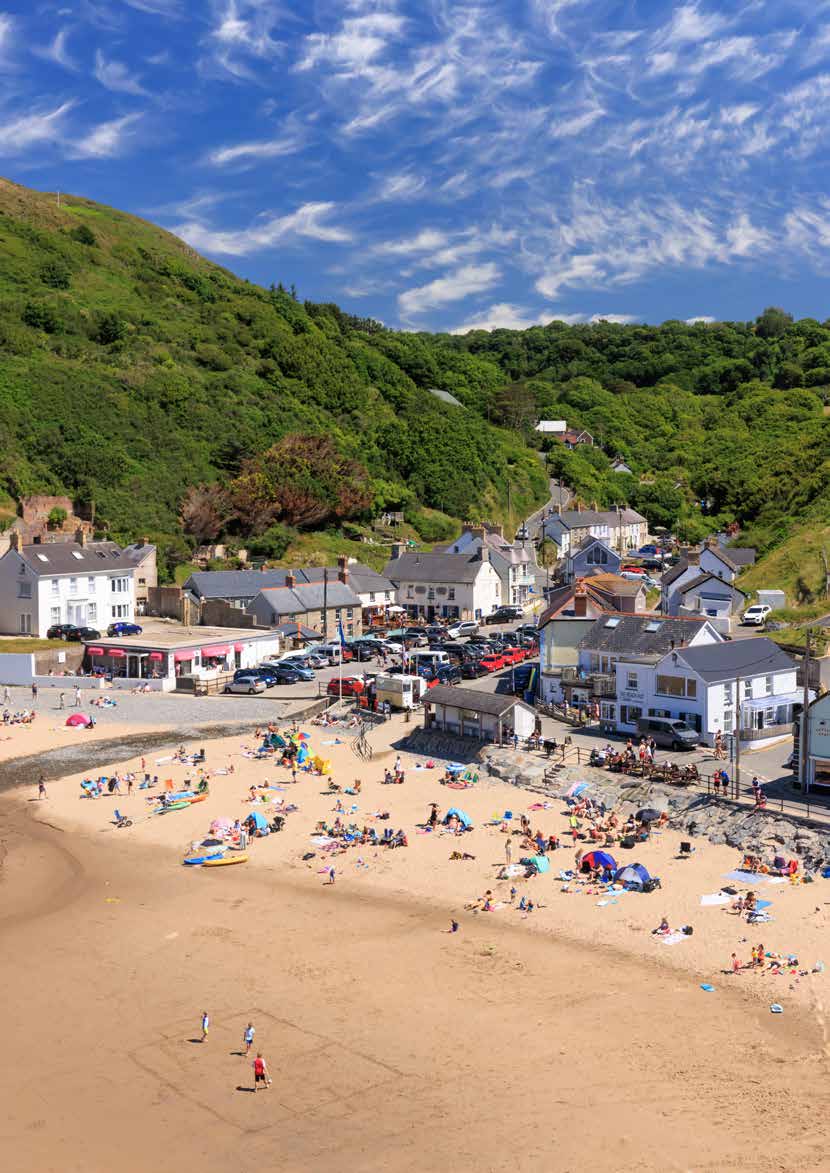
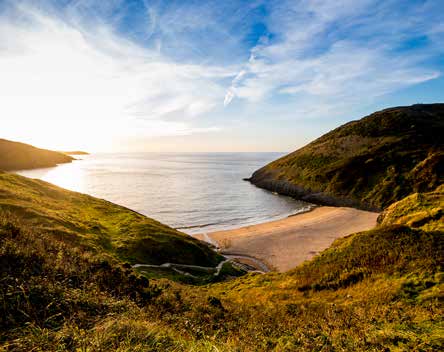
Stuart Millson enjoys a beer and an ice cream in the beautiful Ceredigion village rich in myth and legend Many of those people who dream of escape and seclusion find themselves drawn to the far-west of our island, to the forgotten valleys, bluffs and coves of Ceredigion or Pembrokeshire. You can often fall into a conversation with visitors from the south-east, or Birmingham, or anywhere else that tends to be built-up – where folk are rushing, week-to-week, to meet deadlines, pay bills, pay mortgages – about a dream to “move here”, to “live in Wales”, to “breathe fresh air for a change”. West Wales certainly has fresh air in abundance: sea breezes from Cardigan Bay and the Irish Sea which rustle through summer cliff-edge gorse bushes, or winter gales that have shaped lone coastal trees into the shapes of rocks or witches. One place on our coast that seems to be a distillate of all these characteristics and longings, is Llangrannog – a village of some 700 souls, about half-an-hour or so’s drive from Cardigan. The village is cradled by steep valley sides, and a winding road with sharp bends snakes down through huddled cottages to the small sea-front where the A giant by the name of Bica was prone to that must human of ailments, toothache, and in a moment of agony, rid himself of the bad molar, tossing it into the sea.
Carreg Bica, the remnants of the giant’s rotten tooth, stands forever guard on the beach at Llangrannog valley widens out into a grand panorama defended by immense rocks and cliff-faces. The sea laps onto the beach – mainly sandy, but with some accumulation of pebbles – and on the days where the waves are choppy, white foam breaks against a curious rock-sentinel, known in Welsh as Carreg Bica. Welsh legend has it that in days, time-out-of-mind, a giant by the name of Bica – the local equivalent, perhaps, to Ireland’s Finn MacCool – roamed Ceredigion. But despite his supernatural bearing, Bica was prone to that must human of ailments, toothache, and in a moment of agony by the seashore, rid himself of the bad molar, tossing it into the sea; the rock of Carreg Bica being in fact the result of that painful extraction.
Some three decades ago, when I was just a visitor to Llangrannog, I happened to buy a locally-produced CD, commemorating the village and its famous rock. The recording began, in English, with a local poet reciting his work. “This is T. Llew Jones reading one of his poems, Carreg Bica, Llangrannog…” I realised then, that I needed to steep myself far more in the Welsh culture: the rest of the reading was in Welsh. I had much to learn. Overlooking the bay and the rock, is another larger-than-life form, a statue of the early Christian Celtic saint, Carannog – staff in hand, as if looking back to the coastal path and in the contemporary clifftop statue, he could certainly be considered a rival to the great wizard, Merlin. Walks and history tours tend to bring on that mid-day or late-afternoon tingle of thirst, so simply stroll down the lane from the saint’s statue, to the welcoming bar of the seafront Pentre Arms, a cosy traditional inn with some enjoyable ales on tap and from which, with every gentle sip of your pint, you can enjoy the hypnotic sight of waves and gulls from the bar-lounge window. Busy in the summer months, but secluded and quiet in winter – just a handful of locals enjoying conversations and catchings-up – the Pentre will set you up for the next leg of your exploration. This time, head back into the village, climbing the gradient back into the valley, and look out, on your right, for a delightful little community garden, where another statue commemorates a local figure: Sarah Jane Rees.
Born in 1839, Sarah Jane belonged to that generation of earnest Victorians, devoted to the ideals of Carannog, who laid the foundation stones of Christianity in this spot and preached here, was well known across the Celtic world.
pilgrimage route for his followers. Carannog, who laid the foundation stones of Christianity in this spot and preached here, was well known across the Celtic world, his name appearing in the romances and rolls of Brittany and Cornwall. On his many travels through ancient Britain, he is said to have met the legendary King Arthur – and certainly, from his appearance Christopher Williams, also drew inspiration from the local folk of the village, painting Holidays – Village Girls at Llangrannog social betterment and communal endeavour. An extraordinary woman, interested in everything from maritime navigation (her father was a ship’s officer); to teaching, to the bardic traditions of the Eisteddfod at which she competed in 1865; she went on in 1901 to lead a new Temperance movement for South Wales – earning her place in the history of the people and nation. It was at about this time - 1905, to be exact - that the English composer, Edward Elgar, journeyed to Cardiganshire for a holiday. Elgar was greatly inspired by the hills and rivers of his own Worcestershire and Herefordshire countryside – his biographers and friends recounting many of the long walks or bicycle rides he made in that “heavenly country”, climbing the Malvern Hills, to the prehistoric earthworks known thereabouts as the British Camp.
Legends beside the sea
He would dream of distant horizons and of the past – emotions that frequently surface in his music. When he came to Llangrannog, he found a similar enchantment – walking the coastal hills, taking in the great views where our own Welsh Iron Age fortifications once stood. One day on his holiday, Elgar heard some local people – shepherds – singing to each other on one of the hillsides – and it must have been a beautiful air, as it inspired one of the rhapsodic, nostalgic tunes in his famous work, the Introduction and Allegro for Strings. It was said that Elgar had a mind to write a Welsh Overture – again, inspired by the Llangrannog visit, but the work, it seems, was never sketched out.
A contemporary of Elgar’s, the Welsh artist, Christopher Williams, also drew inspiration from the local folk of the village, painting Holidays – Village Girls at Llangrannog – a scene which, in its mood and sense of place, could easily be recognised by any modern visitor to this Welsh seaside. Williams, like Sarah Jane Rees, was also involved with the National Eisteddfod, and played an important role in establishing Welsh artistic and educational endeavours and institutions on a par with such bodies as the Royal Academy. The warm weather brings the visitors to Llangrannog. A dip in the sea, a snooze on the beach, an ice cream – all the traditions Stay, dine and relax at the Pentre Arms Hotel, located just moments from the beautiful beach in Llangrannog, West Wales.
Enjoy comfortable bed & breakfast accommodation, delicious home-cooked food, and a fully stocked bar with real ales, wines and spirits – all served in a warm and welcoming coastal pub atmosphere.
of a holiday in Britain. Yet as the afternoon draws to a close and the sandcastles begin to flake away, before you head back to your lodgings – or to the pub for another refreshing pint, take one last look out to sea, and to the rugged cliffs, and remember the giants who once came to this intriguing and beautiful place.
Whether you're stopping for lunch, drinks with friends, or a relaxing overnight stay on the Ceredigion Coast, the Pentre Arms is the perfect place to eat, drink and sleep.
The cultural history of Llangrannog
• Comfortable en-suite bedrooms • Homemade meals & locally sourced fish • Real ales, wines & spirits • Dog friendly bar area • Ideal stop on the Ceredigion Coastal Path Strasbourg glowed in the afternoon sun. In Breisach, they chose a scenic drive through the Black Forest before wandering Freiburg’s medieval streets with a local guide. On board, the Chef’s Dinner of signature dishes and carefully chosen wines was already highlight. When they reached Switzerland, they opted to ascend the Bernese Oberland, where snow-capped peaks rose into the sky. In Lucerne, they strolled across the Chapel Bridge.
Throughout the voyage, everything had been arranged; transfers, tours, local experiences, exceptional dining and service. Yet there was always the freedom to do as they wished. As the ship sailed into Basel there was no sense of an ending, just an understanding that they hadn’t been ticking off landmarks, but experiencing them. A journey where the river set the pace and every detail had been beautifully, painstakingly arranged.
rom the moment they landed in Cologne, everything flowed: a private transfer awaited and within the hour a glass of champagne was handed to them by a member of the English-speaking crew. Their cabin felt more like a boutique suite. This would be a trip to remember, planned and organised by Sherrie Broom of Not Just Travel. Sherrie arranges every aspect of her clients’ bespoke adventure, ensuring they enjoy the trip of a lifetime without the stresses that can accompany a holiday abroad. As the ship eased toward Koblenz, they enjoyed a relaxing breakfast. Once in the city, their guide led them to medieval lanes and hidden squares. Afterwards, they lingered in a café — because they could. There was no rigid schedule, just a gentle structure to meet their needs.
Sailing the Rhine Gorge, fairytale castles topped rugged rock faces. At Rüdesheim, a private wine-tasting awaited. In the evening, they sipped brandy as the ship cruised for Speyer and its cathedral. Crossing into France, the spires of Indulge in an escape designed to restore, refresh, and rejuvenate. Begin your experience with two blissful hours in our state-of-the-art thermal suite, where soothing heat experiences, calming steam, and tranquil surroundings invite you to unwind completely and leave the stresses of the outside world behind.
Your journey continues with the luxurious OSKIA Vitamin Glow on the Go Facial, a 45-minute radiance-boosting treatment renowned for its nourishing, rich formulas.